Wednesday, October 1, 2014

Hackers charged for swiping military and Xbox data

The Department of Justice has announced that four hackers,
part of what is being referred to as an "international
computer hacking ring" -- have been charged for stealing
data and software related to the Xbox and belonging to the
military. Two of the four hackers have plead guilty to the
charges. The group is said to have stolen proprietary software used by the
military to train Apache helicopter pilots, and to have swiped
trade secret data related to the Xbox One and Xbox Live, as well
as the games Modern Warfare 3 and Gears of War 3. The charges
took place back in April, but have only now been unsealed.
Says the Justice Department, the four entered into conspiracy to
infringe on copyrights, commit computer/wire/mail fraud, trade
secret theft, and identity theft, among other things. One of the
hackers in particular, David Pokora of Ontario, is the first foreign
person convicted of US trade secret theft via hacking.
The aforementioned data was acquired by hacking into networks
belonging to the US Army, Microsoft, Epic Games, Valve, and
Zombie Studios. Login credentials were swiped and used to
acquired the data, which included source code for Xbox Live,
simulators for Apache helicopters, and pre-release versions of
MW3 and Gears of War 3.

Saturday, September 20, 2014

iCloud hacking: Now, 'nude photos' of Kim Kardashian West, Vanessa Hudgens leaked

Photos showing an apparently nude Kim Kardashian West are
among a group of images that have appeared online in what
appears to be a second leak of hacked personal pictures of
celebrities, weeks after stars including Jennifer Lawrence and
Kate Upton were targeted.
The actresses Vanessa Hudges and Aubrey Plaza, designer and
former child star Mary-Kate Olsen, and US soccer player Hope
Solo are reportedly also among those apparently hacked.
In the self-shot pictures being shared on online message board
4chan, Reddit and Twitter, the woman pertaining to be Kim
Kardashian West is not wearing a wedding ring and it is unclear
when the photos were taken.
Photographs of Hayden Panettiere and Eyes Wide Shut actress
Leelee Sobieski also feature in the latest cache, according to
Buzzfeed.
Further pictures of Lawrence are also reportedly circulating.
Earlier this month over 100 household names were the target of
online thieves, who stole scores of naked photographs and
intimate videos and posted them on the website 4Chan.
Several of the images - in particular, two of Hunger Games star
Lawrence - quickly circulated on Twitter.
The original list had also included Kim Kardashian West, Olsen
and Hudgens, as well as Ariana Grande, Jessica Brown Findlay,
Mary E Winstead, Rihanna, Mary E Winstead, Cara Delevingne,
Kate Bosworth, Selena Gomez, Kate Upton, Kirsten Dunst and
Kaley Cuoco.
The FBI and Apple are both conducting investigations into the
apparent widespread invasion of personal accounts thought to be
connected to the iCloud service.
A spokesperson for Lawrence said at the time: "This is a flagrant
violation of privacy. The authorities have been contacted and will
prosecute anyone who posts the stolen photos of Jennifer
Lawrence."
Justice and Grande both said that the pictures were fake,
although Lawrence's spokesperson verified their authenticity.
Representatives for Upton said they were "looking into" the
authenticity of the intimate images.
Ricky Gervais went on a back tracking spree on the social media
site after he was criticized for 'victim blaming', while Emma
Watson also took to Twitter to voice her condemnation of the
breach.

Thursday, September 11, 2014

Five million Gmail addresses and passwords dumped online


An archive containing nearly 5 million Gmail addresses and plain text passwords was posted Tuesday on an online forum, but the data is old and likely sourced from multiple data breaches according to one security firm.

A user with the online alias “tvskit” posted the archive file on a Bitcoin security forum called btcsec.com and claimed that over 60 percent of credentials found inside are valid.

“We can’t confirm that it is indeed as much as 60 percent, but a great amount of the leaked data is legitimate,” said Peter Kruse, the chief technology officer of CSIS Security Group, a Danish security company that provides cybercrime intelligence to financial institutions and law enforcement.

CSIS researchers analyzed the data and concluded that it is up to 3 years old based on correlations with past leaks.

“We believe the data doesn’t originate from Google directly,” Kruse said via email. “Instead it’s likely it comes from various sources that have been compromised.”

This means that many of the leaked passwords do not correspond to Gmail or Google accounts, but to accounts on other sites where users have used their Gmail addresses as the user name.

CSIS has confirmation that at least five of the leaked user name and password pairs were never used as log-in credentials for Gmail or Google accounts. This enforces the idea that the data comes from compromises outside Google, though it’s possible that they were all perpetrated by a single individual or group, Kruse said.

“The security of our users is of paramount importance to us,” a Google representative said Wednesday via email. “We have no evidence that our systems have been compromised, but whenever we become aware that an account has been compromised, we take steps to help our users secure their accounts.”

Even if many of the leaked credentials turn out not to be from Google, affected users might still want to change their passwords on websites where they used their Gmail address as the user name. A website called isleaked.com allows users to check if their email address is among those leaked.

Friday, September 5, 2014

NVIDIA sues Samsung, Qualcomm for patent infringement

Samsung might find itself in court again, but this time not
against Apple and this time not alone. NVIDIA has filed a
lawsuit against both Samsung and Qualcomm, accusing
them of infringing on 7 of its patents related to computer
graphics and is asking the International Trade Commission
and in the U.S. District Court in Delaware to confirm that,
ban devices, and award them damages. No one will perhaps question that NVIDIA owns patents related to
computer graphics technology. No one will also perhaps deny the
contributions the company has made to the field. Perhaps there
are even some actual patent infringement to be found in its
competitors products, too. But there are many parts of this
lawsuit that are just quite difficult to fathom, much less stomach.
For example, NVIDIA's blog post lists seven infringed patents, a
detail that seems to be missing from its official PR statement.
Among those, four are given as follows:
#our foundational invention, the GPU, which puts onto a
single chip all the functions necessary to process
#graphics and light up screens
our invention of programmable shading, which allows
non-experts to program sophisticated graphics
#our invention of unified shaders, which allow every
processing unit in the GPU to be used for different
purposes
#our invention of multithreaded parallel processing in
GPUs, which enables processing to occur concurrently
on separate threads while accessing the same memory
and other resources
Like many software patents these days, those sound very
commonplace and those are the very same foundational
processes or algorithms used in graphics architecture everywhere.
Surely, others in that market, like once bitter rival ATI (now AMD/
ATI) would have a word or two to say about that.
The targets of the lawsuit are equally perplexing. It specifically
names Samsung and Qualcomm as the culprits. But in the same
breadth, it actually mentions a lot more. Qualcomm is being
targeted for its Adreno GPU used in its Snapdragon SoCs. But the
list of Samsung's devices also include those that run on its own
Exynos chips and so ARM's Mali and Imagination Technologies'
PowerVR graphics architectures are also dragged into the lawsuit.
In short, NVIDIA is basically targeting almost every mobile GPU
maker or designer in the market.
Here's the list of Samsung devices that NVIDIA says infringe on
its patents:
Galaxy Note Edge
Galaxy Note 4
Galaxy S5
Galaxy Note 3
Galaxy S4
Galaxy Tab S
Galaxy Note Pro
Galaxy Tab 2
NVIDIA claims that this is the first time ever that they have filed a
patent lawsuit against anyone in its 21 years of existence. It does
make us question why it took them long to target these chips that
have been in the market for so long. It is also strange that it is
going after Samsung alone, considering the Adreno, Mali, and
PowerVR chips have other customers as well. NVIDIA also says
that it has repeatedly approached Samsung for licensing
negotations but has been repeatedly told that it is the problem of
Samsung's suppliers, which might actually be true as well.
Whatever NVIDIA really has in mind when it filed its complaint, it
might turn out to become a PR problem for them. While it doesn't
fit the definition of a patent troll, there will be many who will
question NVIDIA's motives and sanity, not to mention its financial
situation.

Friday, August 15, 2014

600 Apple iPhones stolen by Apple Employees


Sometimes it is those on the inside that you need to be worried about the most. In Fort Lauderdale, six Apple Store employees were snagged by the cops, as law enforcement smashed an iPhone theft ring that worked out of an Apple Store at the tony Galleria Mall. The six worked together to rip off the store out of 600 iPhones, valued at half a million dollars.

The scheme involved a number of thieves who wandered into the Apple Store, pretending to be customers. In the store, these "customers" would be helped by one of the six employees in on the scam, who would exchange a stolen iPhone for a brand new unit. The Apple Store employees who helped the transactions go through, were paid between $45 and $75 per unit for facilitating the exchange.

The cops arrested former Apple Store employees Devon Persad, Daniel Michael Scotti, Adam Alvarez, Anthony Joseph Tranchida, Sadia A. Dandia, and Otis Jerrell Ferguson. A seventh person arrested was Best Buy Mobile employee Sean Flynn. Flynn provided a list of serial numbers from smartphones on the shelves at Best Buy Mobile, to the other criminals. These numbers were used on the new iPhone models stolen from the Apple Store. 

The cops are looking to identify those who brought the stolen phones into the Apple Store. They are also still looking to find the buyers of the new units that the stolen phones were exchanged for. A Broward Country prosecutor says that the phones were probably sold overseas.

The scheme was discovered when the stolen phones sent in to Apple from the Apple Store, sent off alarms in Cupertino. At the same time, some customers of the Best Buy Mobile store were complaining that they could not get their newly purchased iPhones to work. That was because their serial numbers had been stolen by Flynn and used on the new handsets smuggled out of the Apple Store.

Alienware Alpha console hits preorder


Alienware's Alpha console has gone up for preorder, no longer waiting for the delayed SteamOS and instead running Windows 8.1 with deep ties into the Steam game library thanks to a homegrown couch-friendly interface. Priced from $549, the Alpha runs a choice of Intel Haswell dual- and quadcore Core i chip, paired with a custom NVIDIA Maxwell GTX GPU with 2GB of its own memory, and up to 16GB of DDR3 system memory. That's all squeezed into a box that's compact enough to fit discretely under your TV.

The matte and gloss finish black box contains a single 2.5-inch hard-drive bay, as well as a choice of wireless cards up to 2x2 802.11ac dual-band and Bluetooth 4.0.

It's not short on ports, either: as well as two USB 2.0 on the front there are two USB 3.0 on the back, along with gigabit ethernet, HDMI out and HDMI in, and an optical audio output. A further USB 2.0 is inside, accessed by a hatch on the bottom.
Alienware's familiar "AlienFX" multicolor lighting is present, though given the size of the console it's limited to just the company logo and the glowing triangle on the notched edge. Each can be independently controlled, as well as set to adjust automatically according to game events.

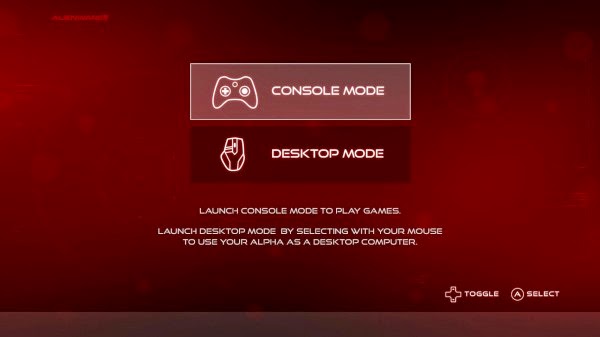
The original plan, of course, was to launch the Alpha with Valve's SteamOS. However, that platform is now delayed, and so Alienware has developed its own Alpha UI that can be controlled entirely with a gamepad and seen all the way across the living room from your couch.

AlphaUI 8
That includes an on-screen keyboard and cursor control, so that you never need to plug in a keyboard or mouse, and support for Steam Big Picture mode. There are more than 500 controller-compatible games in the Steam library, but you can also go into the regular Windows 8.1 desktop and do anything you would with a regular PC.

Alienware also supports what it's calling "Open Console", a platform which will allow the Alpha to be modified and then those custom versions shared with other owners.

It's compatible with the Xbox One controller and the Xbox 360 controller, and there'll be four versions at launch with varying CPUs, storage, and memory; a single Xbox 360 pad will be in the box too. Preorders begin today, from $549.

Thursday, August 14, 2014

The Top 5 Most Brutal Cyber Attacks Of 2014 So Far


In 2014, cyber attacks and data breaches don’t look like they’re going to slow down. We’ve seen high-end data breaches of large companies, with data, personal records and financial information stolen and sold on the black market in a matter of days.

Analysts, Hold Security, startlingly announced in February that it had managed to obtain a list of 360 million account credentials for web services from the black market. That’s just after three weeks of research.

Criminals are stepping up their game and data breaches are becoming both common and devastating. According to research from Arbor Networks, the number of DDoS events topping 20Gbps in the first half of 2014, are double that of 2013. With more than 100 attacks at over 100Gbps or higher recorded in the first half of the year.

Akamai Technologies AKAM +2.05%’ State of the Internet report also showed that hacker attacks on websites went up 75% in the final quarter of 2013, with hackers in China responsible for 43% of all attacks.

This incredible interactive map from Antivirus software firm Kaspersky, which depicts all the current cyber attacks occurring around the world in real time, shows the growing intensity of hacks as the year progresses.

We’re only half way through the year, but there has already been a few high-profile hacks that have stopped presses. Here I’ll explore – in no particular order – the most brutal hacks that have taken place in 2014 so far.
Ebay

eBay went down in a blaze of embarrassment as it suffered this year’s biggest hack so far. In May, eBay revealed that hackers had managed to steal personal records of 233 million users. The hack took place between February and March, with usernames, passwords, phone numbers and physical addresses compromised.
eBay

Hackers successfully stole eBay credentials and managed to gain access to sensitive data. eBay encouraged users to change their passwords and reassured them that financial information was not stolen, as it’s stored separately and encrypted. Although there were further concerns that the stolen personal information could leave eBay users vulnerable to identity theft.

Despite eBay not confirming who was behind the attack, the notorious Syrian Electronic Army claimed responsibility. Despite the huge data breach and the sensitivity of the data, the SEA said that it was a “hacktivist operation” and that they “didn’t do it to hack people’s accounts”.
Montana Health Department

The State of Montana’s health department revealed that a data breach may have affected more than 1 million people. The hack actually happened in July last year, but it wasn’t discovered until May this year, with the identity of the intruders, and the extent of the damage done, still unclear.

The state government said that it is notifying 1.3 million people including current and former residents, families of the dead and anyone else whose personal information may have been accessed in the attack.

It’s not clear if the attackers made-off with sensitive information, or if it had been used or sold on the black market. Richard Opper, director of the state’s Department of Public Health and Human Services, said that there’s “no indication” the hackers accessed the information or used it inappropriately.

If they did, hackers would’ve gained access to highly personal information such as Social Security numbers, medical records, medical insurance records, names, addresses and birth certificates. Not to mention the bank details of all health department employees.
P.F. Chang’s

The chain restaurant suffered a huge data breach last month that compromised customer payment information. Chang’s didn’t specifically mention how many customers had been affected, but thousands of newly stolen credit and debit cards went up for sale online on June 9th.

Several banks had gotten in touch with Brian Krebs, a security journalist, to say that “they acquired from this new batch, multiple cards that were previously issued to customers, and found that all had been used at P.F. Chang’s locations between the beginning of March 2014 and May 19, 2014.”

Criminals managed to hack P.F Chang’s point of sale machines and record credit and debit card data, which then found its way on to the black market. Stolen records were being sold for between $18 and $140, with the price depending on how fresh the stolen data is. Chang’s responded by going low-tech and using age old manual credit card imprinting machines to take payment in its stores, which it then upgraded to new “encryption-enabled terminals”.

Chang’s is still working with the US Secret Service to discover the identity of the hackers.
Evernote and Feedly

It’s not clear if the attacks on both Feedly and Evernote were connected, but they happened within a day of each other and the two companies work largely in tandem. Whilst Evernote was taken down with a Distributed Denial of Service (DDoS) on Tuesday June 10th and was quickly restored within a few hours, Feedly, which went down the next day, suffered much more.

Evernote

The news aggregation service was attacked in the early hours of Tuesday morning. CEO of Feedly, Edwin Khodabakchian, announced on Feedly’s official blog that the attack had been “neutralized” and that normal service had restored. However, two more DDoS waves were launched at Feedly which bought it down for another two days, with service being properly restored on June 14th.

Not much about the attacker is known, other than that they attempted to extort money out of Feedly in exchange for ending the attacks.  Khodabakchian said that he refused to comply with the attacker’s ransom demands and the threat, eventually, was neutralized.
Domino’s Pizza

Hacking group Rex Mundi held Domino’s Pizza to ransom over 600,000 Belgian and French customer records. In exchange for the personal data, which included names, addresses, emails, phone numbers and even favourite pizza toppings, Mundi demanded $40,000 from the fast-food chain.

If the ransom wasn’t met, the hackers threatened to publish the information online. The group then taunted Domino’s by saying: “Earlier this week, we hacked our way into the servers of Domino’s Pizza France and Belgium, who happen to share the same vulnerable database. boy, did we find some juicy stuff in there.”

Domino’s refused to comply with the ransom and reassured customers that financial and banking information was not stolen. The hacking group had its Twitter account suspended and the data was never released, although it’s not clear if Domino’s ever complied with the ransom demands.